"Desde mi punto de vista –y esto puede ser algo profético y paradójico a la vez– Estados Unidos está mucho peor que América Latina. Porque Estados Unidos tiene una solución, pero en mi opinión, es una mala solución, tanto para ellos como para el mundo en general. En cambio, en América Latina no hay soluciones, sólo problemas; pero por más doloroso que sea, es mejor tener problemas que tener una mala solución para el futuro de la historia."

Ignácio Ellacuría


O que iremos fazer hoje, Cérebro?

domingo, 15 de agosto de 2010

Exportações alemãs se recuperam puxadas pela economia chinesa

Germany: On a roll

By Daniel Schäfer in Frankfurt

Published: August 15 2010 20:31 | Last updated: August 15 2010 20:31

Rolled steel


At the ready: galvanised steel at ThyssenKurpp's Duisburg works. A boom in German industry’s order inflow is spurring a new winingness by companies to invest in upgrading their facilities

When Peter Löscher, Siemens’ chief executive, told the Financial Times in May last year that Germany would emerge from the recession to “spearhead a fresh wave of industrial revolution”, it seemed a rash prediction. At the time, Europe’s largest exporting country was in the middle of its deepest recession in more than 60 years.

Just 15 months on, Mr Löscher’s vision is becoming reality. The German export engine has surged back to life and is leading the continent out of the crisis, emerging faster from the downturn than many of its neighbours. Germany’s gross domestic product jumped 2.2 per cent in the second quarter from the preceding three months, taking the front rank in the eurozone. Friday’s data prompted several economists to predict that its economy will grow by at least 3 per cent this year.

Production levels, exports and profits are rising rapidly in important sectors such as machinery, cars and chemical goods, while unemployment has reached the lowest level in several years. The strength of this “XL upswing” – as Rainer Brüderle, economics minister, calls it – is such that he clichéd German angst has evaporated. German businesses are basking in a summer optimism that contrasts sharply not only with the country’s oft-seen pessimism but also with the dark mood in the US and the uncertainty that pervades other parts of Europe. Business confidence in Germany last month reached its highest in three years.

Yet there remain risks that threaten to derail the upswing – and not only because some sectors of the economy might be in danger of overheating. Growth is likely to slow in the remainder of the year, when government austerity measures kick in and companies’ inventory restocking is expected to wane. But many executives are even more concerned that Germany’s “new economic miracle” – as the domestic media call it – could really be a Chinese economic miracle.

In large parts of the economy, from premium cars to textile machines, demand is being heavily driven by China – raising questions over the extent of the country’s dependence on a market whose growth has already started to slow.

For now, however, German industrialists have plenty of reasons to be cheerful. Many plants are running at full speed again, some companies are expanding capacity and many are re-hiring contract workers. Orders in the engineering sector, Germany’s economic backbone that includes industrial giants such as Siemens as well as swaths of midsized family-owned companies, shot up by 32 per cent year-on-year in the first six months, following a drop of 38 per cent in the past year.

The order boom is spurring a new willingness to invest. After several years in which companies squirreled away most of their cash, many are ready to replace old equipment and expand their businesses. SAP, the world’s largest business software maker, says its German sales grew at a double-digit rate in the first half of this year. “If you think about a company like SAP with such a mature brand and a well-founded marketplace growing at that rate, it speaks to the depth of the turnaround,” says Bill McDermott, co-chief executive.

Several large manufacturers – from Siemens to companies such as Audi, the premium carmaker that is part of Volkswagen – are heading towards record profits this year, driven by a weak euro and a strong position in Asia. Daimler, Audi and BMW all reported record operating profit margins of more than 9 per cent in their luxury automotive businesses in the second quarter, thanks to rapidly rising demand for their high-margin top-class models but also helped by hefty cost cuts initiated in the past few years.

“Germany is benefiting from its industrial strength and export power,” Siemens’ Mr Löscher says, pointing to the country’s technological edge in growth areas such as infrastructure and green products. Industrial products such as cars, machinery and medical devices make up almost one-quarter of gross domestic product – much more than in most European countries. Germany sold goods worth $13,681 (€10,728, £8,777) per head of population last year, far ahead of France and twice as much as third-ranking Italy.

One reason is Germany’s openness to the world, says Hermann Simon, chairman of Simon Kucher & Partners, a German consultancy. “Germans go on holiday everywhere around the globe, whereas other Europeans tend to stay at home and do not get to know the world,” he observes.

Certainly, German industrial groups were often faster than others in tapping markets outside Europe. VW entered China more than 30 years ago, for instance, sowing the seeds for today’s market dominance by the multi-branded carmaker. Some of the larger family-owned Mittelstand engineering companies, such SMS Group, a producer of metal processing machines, have been present in China for many decades.

Mr Simon says German specialisation in high-quality market niches makes a lot of its industrial products indispensable: “Companies can postpone such investments but they cannot omit them altogether.” He points to Trumpf, the laser-cutting machine maker, saying: “If all machines made by Trumpf were suddenly to disappear, the global economy would simply collapse, as all sophisticated metal processing companies would have to close down their businesses.”

T  he twin focus on market niches and exports – even small family-owned engineering companies often sell more than 80 per cent of their production abroad – has left German industry exposed to an amount of volatility that runs contrary to the country’s stability-loving mentality. Ulrich Reifenhäuser, owner of the eponymous plastics machinery maker, says of his experience in the past two years: “First we went into a brutal tailspin and now we are in the middle of a steep climb.”

But after strengthening their competitiveness and radically improving their workforce flexibility in the past decade, most companies were able to cope with the roller coaster ride. Many businesses held on to their core staff during the crisis, helped by their own flexibility measures as well as a government-sponsored short-time working scheme where the state chips in for as much as two-thirds of wages lost when working hours are reduced.

“Germany did a great job during the crisis. The consensus between employers and employees allowed managers to concentrate on business,” says Axel Heitmann, chief executive of Lanxess, a large speciality chemicals company. The main pillar of this consensus has been that trade unions such as IG Metall were willing to focus on job security instead of demanding pay rises during the crisis.

This hibernation strategy came at the expense of a temporary drop in labour productivity, but it has paid off because it enabled companies to accelerate swiftly out of the slump. Reifenhäuser is a typical example. When orders more than halved in 2009, the group shed its 120 temporary workers and put large numbers of its 1,200 permanent staff on short-time working. As business came back forcefully this year, the group rapidly re-hired temps and switched back to full production and in some areas even special extra shifts.

While the short-time working scheme known as Kurzarbeit will cost the German state €6bn ($8bn, £5bn) this year alone, it helped to keep unemployment at a low level throughout the crisis. This supported the population’s willingness to spend money, although consumption stayed at its usual low level. In July, unemployment stood at 7.6 per cent, one of the lowest rates in years.


Flexibility measures such as Kurz­arbeit helped deal with most of the supply problems that had been dreaded at the initial stages of this apparently V-shaped recovery. While a few smaller suppliers struggled to meet demand in the first half of the year, most companies were quick to reinstate capacity. But some of the most cyclical areas, such as microchips, remain a problem. Infineon, the chipmaker, is for instance lagging behind on its production. In June, Audi and Porsche came close to having to halt car production in some of their plants after Harman Becker, their supplier of car stereos, ran out of the chips its units needed.

“Such a fast recovery cannot go without friction. We had massive problems at the beginning but now production is running smoothly again,” says Mr Reifenhäuser.

But what worries many industrialists is how lopsided the growth is towards Asia and other emerging economies such as Brazil, bringing a large part of corporate Germany into a dangerous dependence on the Chinese market in particular. “Without China we would hardly have seen this recovery – it’s a frightening trend,” says Hannes Hesse, head of the VDMA engineering association, adding that demand for textile machines is “almost exclusively” Chinese.

The position is similar, if not quite so extreme, for carmakers. VW calls China its second home market but it really is its first: it sells more cars there than in Germany. Daimler says 20–30 per cent of its sales growth comes from China. But Dieter Zetsche, chief executive, rejects suggestions that it is becoming dependent on that market, saying: “We have a high profitability there but certainly do not have all our eggs in one basket.”

But few doubt that a slowdown in China would hit the German economy harder than others. A number of German industrialists are already warning that the second half of the year will be tougher. “There is no reason to become overly optimistic. . . We see a waning recovery in the US and Asia will grow more slowly in the second half,” says Jürgen Hambrecht, chief executive of BASF, the largest chemical maker in the world.

China’s gross domestic product growth slowed from 11.9 per cent to 10.3 per cent in the second quarter from the first, reflecting government efforts to restrict bank lending. A continued softening would threaten to derail Germany’s export boom at a time when government austerity measures in Europe are upsetting growth prospects in its own backyard.

“In western Europe and particularly in Germany, we expect demand to be weak in the second half of the year. And in China, there is also a chance for a soft cooling down in the second half,” says Hans Dieter Pötsch, VW’s chief financial officer.

But such warnings cannot spoil the summery optimism in Germany. Many companies take heart from their overflowing order books, which provide a cushion for a time when the economy will lose momentum. Siemens, for instance, reported an €89bn order backlog last month, the highest in its 163-year history.

“All over the place, we see a stabilisation of the global economy,” Mr Löscher says. “German companies are present on all international growth markets and can profit from this upswing.”

http://www.ft.com/cms/s/0/95292e5a-a898-11df-86dd-00144feabdc0.html

Editorial do jornal indiano “The Hindu” publicado após indepedência da Índia em 1947

Published: Agosto 15, 2010 03:12 IST | Updated: Agosto 15, 2010 18:20 IST Agosto 15, 2010

A Red-letter day


Pandit Jawaharlal Nehru being sworn in as Prime Minister of India at the Viceroy's House in New Delhi on August 14, 1947 midnight by Lord Mountbatten, the Viceroy. Photographer: Pandit Nehru being sworn in Prime Minister of India at the Viceroy's House in New Delhi on August 14, 1947 midnight by Lord Mountbatten , the Viceroy. Photographer:

The Hindu Photo Archives Pandit Jawaharlal Nehru being sworn in as Prime Minister of India at the Viceroy's House in New Delhi on August 14, 1947 midnight by Lord Mountbatten, the Viceroy. Photographer: Pandit Nehru being sworn in Prime Minister of India at the Viceroy's House in New Delhi on August 14, 1947 midnight by Lord Mountbatten , the Viceroy. Photographer:

The Hindu's editorial on India's independence that was published on August 15, 1947.

BY the grace of Providence India enters the comity of free nations to-day, an equal among equals. It is an occasion for rejoicing not only for her people but for all who value human freedom as an end in itself. So long as this country with her hoary civilisation and many-sided culture, her wealth of resources and matchless opulence of spirit remained in political bondage, that very fact constituted an implicit denial of those values to which the dominant nations of the West were wont to pay lip service. That India has at long last achieved her independence by agreement with Great Britain is a fact for which the sagacity and statesmanship of Britain is entitled to the fullest credit. Other imperial Powers are bound to follow in her footsteps sooner or later; for the heart has gone out of Imperialism. The harrowing experience of two wars within a single generation is to a large extent responsible for this awakening among the ruling Powers. But the way in which the people of India have conducted their struggle for emancipation has not been without its influence in bringing about a change in the world outlook. The outstanding marvel of this century is the faith inspired in millions of people that truth may prevail, unbacked though it be by the big battalions,, that you may win over your adversary by putting him on his honour, relying on his good faith and appealing to his reason. By imbuing his countrymen with this faith and sustaining it through the long night-of darkness and despair Mahatma Gandhi has not only won for himself a secure place in our affections; he has placed all humanity in his debt. To him and to the countless men and women who sacrificed themselves cheerfully that others might live to breathe the ampler air of freedom, our hearts turn to-day in reverent homage.

We have achieved freedom; But at what cost! A country and a people that by every test are a unity have been arbitrarily divided. And the wound will take long to heal; for, as Mr. Nehru has sadly remarked, "division has taken place in the hearts of the people of India". But it is idle to brood over what has happened and foolish to get angry and cast about for scapegoats. Many think that there is bound to be a reunion when there has been time enough for people to reflect coolly on the disastrous consequences of this unnatural partition. That is as it may be. But those who are perpetually harping on it, whether from genuine distress or in a fractious spirit, will not be hastening that consummation. It can only act as an irritant. The temptation for the protagonists of a united India and of Pakistan to talk at each other from a distance should be set aside. And both sides should concentrate on the thousand and one practical tasks that will have to be tackled in a spirit of mutual accommodation if life is not to be unnecessarily hard for large masses of men. The responsible leaders have shown a praiseworthy desire to conciliate the minorities and to reassure them. But so long as Lahore, Calcutta, and other big cities remain in the grip of madmen drunk with blood and the civil power stands helpless in the face of organised murder and loot, it is idle to expect the minority communities to be satisfied with verbal assurances however ample. From today the responsibility for ending this disgraceful state of affairs is solely ours. Neither the Government of India nor that of Pakistan must overlook the fact that our new-won freedom is itself gravely menaced by this chronic lawlessness. Every effort should, of course, be made to rally the vast majority of peaceable citizens in support of law and order. But the long arm of the law should be not less ready to collar and swift to punish the malfactors however deeply they might be entrenched.

We have won freedom. And the first thing our people must learn is that it is no picnic. They will have to gird their loins and work as they have never worked before. Any number of paper plans will not usher in the millennium if we go on interminably arguing their relative merits. The consensus of instructed opinion in the country is that our urgent need is to increase production. Dr. John Matthai. in stressing the other day the fact that the redressing of the present gross inequality in distribution is no less essential, was no doubt applying a healthy corrective. But, while admitting this, we would point out that there is some risk in envisaging the pursuit of economic equality in terms of a struggle. Dr. Matthai argued that like all national movements for freedom ours too, has had to lean heavily on vested interests and the latter have taken the fullest advantage of this; and that a determined effort should now be made to shake off this strangle-hold and this could be done, and the energy released by the achievement of freedom could be best utilised by casting vested interests for the role of enemy as we cast British Imperialism for that role till the other day. Dr. Matthai was, we are sure, merely using picturesque language to emphasise his point. But there is a danger in simplifying these things, especially with a people who are still novices in the art of political democracy. We have to deal, not with lifeless things that stay put, but with a dynamic situation which changes under our very eyes. Those who led the fight for freedom yesterday may themselves come to be regarded as vested interests by their self-styled successors of to-day who claim to lead the struggle for economic equality. In act, the epidemic of strikes that has broken out in many key-industries and that is further impoverishing an economy that is already dangerously on the verge of collapse, is often sought to be justified on the ground that the bourgeois leaders are in league with the capitalists. If these ideological recriminations are given their head, we must bid farewell to all hopes of a united drive for maximising production and for opening up new and fruitful fields of economic activity.

Having pinned our faith to the method of peaceful persuasion in our struggle for emancipation it would ill become us to look upon the coercive exercise of the State power as the inevitable instrument for building up a strong and well-knit nation. Among us, as in other parts of the world, there are bound to be wide differences of opinion as to the objectives of State policy. All rational men aim at the good life as the goal of the State; but. though there is general agreement in regard to the material conditions which the term implies, there are considerable differences of opinion over the spiritual values which are no less essential to the good life, such imponderables, among others, as freedom of thought itself. Far from regarding it as necessary in the interests of the public welfare to steam-roller opinion at the behest of a dominant clique, our age-long tradition, to which totalitarian tyranny is profoundly repugnant, has always favoured the allowing of the maximum liberty to people to live their Own lives without denying others their due. If we are to be true to our own best impulses we should depend on education rather than legislation, on the catalytic action of creative thought and not on mass agitation and crude propaganda, to bring about those changes which may be necessary to eliminate poverty, wretchedness and strife and to enable every citizen of free India to attain to fullness of life and that inner freedom which the Vedic seers termed Swaaraajya

http://www.thehindu.com/opinion/editorial/article571011.ece?homepage=true

Los agujeros negros del planeta

No link abaixo há um conjunto de reportagens do jornal espanhol “El País” sobre alguns dos lugares mais pobres do mundo.

Los agujeros negros del planeta

Más de mil millones de personas viven en el mundo con menos de un dólar diario y más de dos mil, con menos de dos. La mitad de ellos son niños. 1.100 millones no tienen acceso a agua corriente y 2.600 millones no conocen las condiciones sanitarias mínimas. La globalización ha aumentado las desigualdades, creando grandes focos de pobreza. EL PAÍS ha viajado a algunos de los cientos de agujeros negros del planeta, en distintos puntos cardinales: Bangladesh, Gaza, Haití y República Centroafricana. Cuatro historias humanas de miseria que se publicarán durante agosto


http://www.elpais.com/especial/los-agujeros-negros-del-planeta/bangladesh.html

Rússia veta exportações de cereais

Rusia veta la exportación de cereales

La medida, que entra en vigor hoy, es consecuencia de los devastadores incendios de las últimas semanas y la persistente sequía

EL PAÍS - Madrid - 15/08/2010

Rusia no exportará cereales hasta finales de año. Moscú ha tenido que tomar esta medida, que entra en vigor, por la drástica bajada de las cosechas debido a los devastadores incendios que afectan al centroy oeste del país desde comienzos del verano y pertinaz sequía, la peor en décadas. Rusia es uno de los principales productores mundiales de trigo, cebada y centeno por lo la paralización de las exportanciones puede provocar una subida de precios en el mercado mundial .

El objetivo del Gobierno ruso es mantener controlado el precio de los alimentos ya que el daño en la agricultura es tan grande que no está asegurado el abastecimiento para todo el país. El ministerio de Agricultura de Rusia revisó esta semana a la baja la cosecha para este año, hasta los 65 o 60 millones de toneladas de grano. Putin reconoció que las necesidades del país ascienden a 78 millones de toneladas de cereales, pero aseguró que éstas se verán satisfechas gracias a los 9,5 millones de toneladas del fondo de intervención y los 21 millones almacenados de otros años.

Según el primer ministro ruso, la suspensión de exportar cereales es "por supuesto, es una medida provisonal, pero nos encontramos en una situación de emergencia y estamos obligados a preocuparnos de nuestros ciudadanos y productores". La medida, que ha causado un alza de los precios en los mercados internacionales y entrará en vigor del 15 de agosto hasta el 31 de diciembre, afecta al trigo, centeno, cebada, maíz y a la harina de trigo y de centeno, pero no al arroz. El pasado viernes, el viceprimer ministro primero, Igor Shuválov, comentó que el Gobierno podría revisar la medida en octubre, una vez que termine la recolección, tras lo que podrían reanudarse las exportaciones.

Rusia había exportado 8,48 millones de toneladas de trigo en el primer semestre del año, un 20,8% más que en el mismo período de 2009, año en que su producción ascendió a 97 millones de toneladas. El Instituto Meteorológico de Rusia ha informado de que la falta de lluvias afectará en especial a dos tubérculos fundamentales para la dieta de los rusos, como la patata y la remolacha, cuya recolección podría caer entre un 30 y 35%.

http://www.elpais.com/articulo/internacional/Rusia/veta/exportacion/cereales/elpepuint/20100815elpepuint_2/Tes

Machiavelli 2.0

Machiavelli 2.0

The Fundamentals of Network Society by Alexander Schellong, Philipp Mueller

Alexander Schellong, PhD, MA, is a Senior Consultant with CSC’s public sector management practice advising clients internationally on issues of eGovernment, citizen relationship management, public management and public policy. Among others, he serves as an expert to the European Commission. He continues to be active in academia through research and lectures. His studies focus on the impacts of ICT and organizational and societal issues. Philipp Mueller, PhD, MA, is director of the Center for Public Management and Governance at the Salzburg University Business School and visiting professor for public policy and management at the Willy Brandt School of Public Policy in Erfurt. His research interests lie in the interplay of ICTs and public policy and he is working with leaders in business and governments worldwide on strategies to adapt to our changing world. Both authors have collaborated in various executive education programs and research projects at Harvard University and elsewhere.

In the sixteenth-century, Machiavelli, a senior policy advisor in the city-state of Florence, Italy, became one of the first thinkers to address the new formations of political power that developed with the advent of modern society. In his seminal work, the prince, he argues for the importance of influencing public opinion. For Machiavelli, attaining the positive opinion of his subjects is the precondition for political effectiveness. Machiavelli believed in the capacity of the people to judge the public good in various settings. This understanding deviates from the monarchic subordination-and-rule approach derived from divine right of his time. In modernity, public opinion, expressed in various forms, became the currency of political legitimacy whether in democracies, monarchies or dictatorships.

The evolution of modern society is marked by continuous rise of government size, obligations and market interactions. According to Juergen Habermas, the expansion of the state into more and more private affairs led to a slow demise of the public debates over ideas and conflicts—the expression varying with context, history, and technology. Citizen-government interaction is reduced to election periods, interest groups and media-spin.

However, there was opposition to this development. Henry David Thoreau argued in his essay “Civil Disobedience” in the late 18th century, “government is best which governs least.” It implies a government reduced to the minimum in size accountable to its people. Because American government in the 18th century was already on its way to assemble the contrary, Thoreau suggested that if as many people as possible join peaceful protests, their actions would “clog the machinery of the state”, eventually leading to change. However, he did not succeed. And over the next 200 years, the state developed as the most successful organization form, an “imagined community” that structured the lives of most people on this planet. Today, however, with the advent of new network-based social platforms, Thoreau might have been more successful with his attempt to let his voice be heard and activate others for his cause.

In the 21st Century the 'network' has transcended the academic context and entered the wider field of the political discourse. Policy networks, networked governance, peer production, massive collaboration, open government, and radical transparency have become part of our political vocabulary that we rely on to legitimize why and how we act collectively. With web technologies and social media, such as interchangeable data-formats, wikis, transparency, and social networking, network society has become part of the mainstream global public policy discourse.

The early 21st Century evoke a Machiavellian time—a time when new technologies and new forms of thinking and governance emerged. So, if we are living in times of transformative change, where Internet technologies and an understanding of society as a network of inclusive, some-how like-minded, outcome-oriented, collaborators emerges we need to ask, what the logic of network society is, to be able to explain our world and predict future developments. Dave Clark, one of the original architects of the Internet, argued in 1971: We reject: kings, presidents and voting. We believe in: rough consensus and running code.

There are two driving characteristics of the networked society: the ease to connect (technology) and the willingness to connect (social legitimacy) which redefine territoriality and increase complexity. The ease to connect stems from technologies that allow us to supersede territorial space and linear time. However, without a willingness to interact, the ability does not lead to a changed world. It is not technological determinism, but the interplay between new social practices and enabling technologies that have transformative potential. So, in a nutshell, there are four main principles and several corollaries that describe network society: the territoriality principle, the complexity principle, the technology principle, and the choice principle.

The territoriality principle

Technology, greater mobility of society or capital—some may refer to it as globalization—facilitates blurring the formerly clear boundaries of territoriality. The Westphalian Order marked by the peace agreement in 1648 ending the 30 Years War in Europe, defined nation-states as entities with fixed territorial boundaries that defined the limits of their legal jurisdiction and the scope of their political authority. Today the fundamental principles and practices of liberal democracy—the nature of citizens, the definition of democratic citizenship, the ideas of self-governance, consent, representation, political spin, popular sovereignty—are almost exclusively associated with the institutions of the sovereign territorial nation-state. Consequently, modern democratic theory and democratic politics assume correspondence between the democratic political community and the modern nation-state: a self-contained, self-governing, territorially delimited national community. Yet world order and sovereign statehood is no longer immutable. The world faces problems such as environmental change, large-scale market failures and terrorism which span the globe, are known to many and which cannot be solved by one entity alone. Thus political issues and action are now also located in the global arena.

The complexity principle

The territoriality principle and the corollaries of the technology principle make the cornerstones of the complexity principle. In the network society, interdependence is increasing. Everything is and can potentially be connected. The recent financial crisis provides us with a case in point. Because of complexity and the capacity (institutional, organizational, and technological) of the nation-state being the strongest within its territory, government faces a crisis of efficiency and legitimacy.

The technology principle

The technology principle includes the corollaries of path dependency, scale and networks effect, real-time, modularity and granularity. The network society is mediated through advances in technology. The Internet, especially, is continuing to play an important part in the change towards network society.

The Path dependency corollary

Path dependency makes it costly for us to exercise choice and leave any given network because of the network effect. Examples are the width of our high-speed railway tracks which conform to the track-width of the mule-trains in the coal mines of Newcastle or Brazilians mainly joining Orkut, Americans joining facebook, and Japanese joining Mixi.

The Scale and Network Effects corollary

Network effects are the glue of network society. In essence, the network effect describes the positive externalities (value) of a product, service, or activity as more people use it. An organization taking advantage of the principle may refer to the practice as “crowdsourcing” (e.g. Wikipedia, Dell’s Ideastorm, iPhone Apps) taking advantage of the “wisdom of the crowds”. Individuals may also aggregate and mobilize for a specific cause, be it political, civic or commercial (e.g. Moveon.org, Ukrainian orange revolution). The emergence of the latter can be of spontaneous and real-time nature.


The real-time corollary

With the reduced need for securing the supply of physical goods, consumers are turning to experiences to find gratification and an escape from everyday life. Moreover, with people’s lives full of obligations and choices, and with only roughly waking 16-17 hours available each day, the more (new) information and activities that can be obtained in a short time, the better. The Netizen, the member of those generations that have grown up with the Internet or use it heavily, constantly hunger for something new—think real-time communication and interaction (e.g. Google Wave, Twitter), real-time news, real-time search or real-time content creation. “Digital” is becoming synonymous with “instantaneously” for many.

The Modularity corollary

Modularity allows complexity through the combination out of simple parts. Examples of modularity at work is when social movements combine technologies such as skype, twitter, and facebook status updates to organize the post-election demonstrations in Iran.

The Granularity corollary

The smaller the useful contribution, the easier the scalability. In the 2009 expense scandal in the British parliament, the Guardian put a website online where they posted all potential infringing documents. By 2010, 25,530 people had visited this website and reviewed 218,587 of the documents, unearthing information that would have never been uncovered.

The choice principle

The choice principle includes the corollaries of consensus, forking, peer-production and transparency. According to the choice principle, any network participant chooses to participate or to leave at any given point in time. However, because of the complexity principle, entities that have chosen to opt-out of a network or a particular activity does not mean they can not be affected by it. Mass society tends unite and disrupt existing communities and traditions over time. The choice principle also accounts for the increasing number of decisions individuals must make on a day-to-day basis (choices include those relating to products, communication channels, information sources, setting.

The Consensus corollary

Decisions in choice-communities are made by consensus. David Clark explains that this does not mean unanimity and certainly not majority voting. It is the mechanism with which the Internet Engineering Task Force (IETF) develops and promotes Internet standards.

The Forking corollary

Forking happens when developers take a copy of source code from one software package and start independent development on it, creating a distinct piece of software. ‏This happens often in open source development projects as well as in online content creation, combining different sources to create new insight.

The Peer Production corollary

Public Commons in network society are produced by peers for peers. Examples of such commons that are playing an ever more important role in our societal and political lives are Ubuntu Linux, Wikipedia, or the Obama volunteers.

The Transparency corollary

Transparency/Documentation takes the role of democracy as the standard against which any governance situation is evaluated. The open government directives and the corresponding data.gov websites in the United States, the United Kingdom, and Australia show how much transparency has become the core legitimizing instrument of governments. At the same time an individual’s private life and experiences become more transparent through technology which opens many avenues for government communication. Along these lines there is also greater transparency about organizations, their activities or products (e.g. thousands or even millions of reviews can be found on products, doctors or hotels). The organizations concerned are either disclosing this information on a voluntary basis or because they are forced by external entities (e.g. consumer initiative; think of a non-profit such as foodwatch) that can build power through the network effect. In addition, transparency is prone to the network effect, too. Transparency in one area increases the expectations of people in other areas (e.g. the idea of Open Government spreading from the U.S. to Europe).

Machiavelli 2.0

With the phenomenon of “web 2.0,” defined by Clay Shirky as ridiculously simple group forming, this trend towards network society has accelerated. The transformative potential of web 2.0 technologies and their accompanying societal practices is derived from four factors: First, they expand the social universe by making cooperation possible in situations where the transaction costs would have been prohibitively high. Wikipedia, Facebook and MySpace are good examples of such services. Second, web technologies compete with existing forms of providing public value. Peer-to-Peer-Music-Sharing platforms are examples, but also new discovery platforms such as Amiestreet or Jamando. Third, they disrupt the balance of power between existing social actors, for example by empowering NGO’s by allowing them to distribute massive amounts of data to the community as the Groklaw example has shown, or by moving power from large to small donors in U.S. Presidential elections. And lastly, they corrode how we do things in existing organisations by giving us new tools that undermine internal information flows and hierarchies.

Because of this four-way assault on our existing societal institutions, even as good followers of Machiavelli, we have to expect dramatic shifts in how we do things in collectivities from the local to the global level. Many societal communities are already functioning according to such principles, most notably in open source development, global terrorism, political campaigning, or the alter-globalization movement. Networked forms of societies are becoming serious alternatives to modern societies and we need to better understand them if we want to succeed in today’s complex policy environments. So in 2010, Machiavelli would advise the prince to build her power base around open networked communities, transparency, standardized interfaces and a bold move to just sail unchartered waters to test their boundaries.

http://hir.harvard.edu/index.php?page=article&id=1926&p=1

Celso Amorim: Política Externa

São Paulo, domingo, 15 de agosto de 2010


OPINIÃO POLÍTICA EXTERNA
Dedo acusador pode render aplauso, mas raramente salva

Atuar com discrição é a expressão da natureza conciliadora do brasileiro
CELSO AMORIM
ESPECIAL PARA A FOLHA
Têm sido frequentes as críticas que apontam para uma suposta "indiferença" -ou mesmo "conivência"- da diplomacia brasileira diante de países acusados de violar os direitos humanos. Trata-se de um juízo equivocado.
O Brasil deseja para todos os demais países o que deseja para si -a democracia plena e o respeito aos direitos humanos, cuja consolidação e aperfeiçoamento têm sido uma das preocupações centrais do governo do presidente Lula.
Consideramos, entretanto, que as reprimendas ou condenações públicas a outros Estados não são o melhor caminho para obter esse resultado. Na verdade, escolher a intimidação em detrimento da persuasão é quase sempre ineficaz, quando não contraproducente.
O dedo acusador pode render aplausos ao dono, mas raramente salva o jornalista silenciado, o condenado à morte, o povo sem acesso à urna ou a mulher privada de sua dignidade. Isolar quem se quer convencer ou dissuadir é má estratégia.
Preferimos dar o exemplo e, ao mesmo tempo, agir pela via do diálogo franco -em geral, mais eficaz. No caso do Brasil, essa capacidade de atuar com discrição não é oriunda de algum talento excepcional; é a expressão, em nossas relações com outros Estados soberanos, da natureza conciliadora do povo brasileiro.
AGENDA
Ações desse tipo são bem menos visíveis do que a admoestação midiática exercida por alguns países contra um punhado de governos, selecionados de forma nem sempre criteriosa ou politicamente isenta. A escolha dos indigitados, além de obedecer a agenda política, muitas vezes revela preconceitos, ora religiosos, ora raciais.
Muitos dos países que se consideram modelares cultivam relações com regimes não democráticos, desde que isso corresponda a interesses econômicos ou estratégico-militares. Os exemplos são tantos que não podem escapar ao mais complacente dos olhares.
Além disso, alguns aplicam, eles próprios, a pena capital. Ou conferem tratamento desumano e degradante a trabalhadores imigrantes. Ou ainda transferem suspeitos sem julgamento para prisões secretas, em voos também secretos. Isso para não falar de ações militares unilaterais, à margem do Conselho de Segurança da ONU, que resultam em milhares de vítimas civis.
O Brasil considera que as referências específicas a outros Estados no campo dos direitos humanos devem ser feitas preferencialmente no âmbito do Mecanismo de Revisão Periódica Universal do Conselho de Direitos Humanos das Nações Unidas (CDH), que, aliás, nosso país ajudou a criar.
Ali se busca o tratamento não seletivo, objetivo e multilateral dos direitos humanos em todos os países-membros da ONU.
Em 2011, os métodos de trabalho do CDH serão revisados. Procuraremos aperfeiçoá-los para que o órgão se torne cada vez mais eficaz e para que possa trazer benefícios diretos àqueles que sofrem violações. Em matéria de direitos humanos, como já declarei diversas vezes, não há país que não tenha algo a ensinar, assim como não há país que não tenha algo a aprender.
No esforço de persuadir, o Brasil se vale da cooperação com organizações ou países da mesma região, que têm muito mais probabilidade de serem ouvidos do que, por exemplo, as ex-potências coloniais ou outras nações cuja ação é percebida como reflexo de arrogância e complexo de superioridade.
Destas, pode-se dizer, como na Bíblia, que percebem mais facilmente o cisco no olho do próximo do que a trave em seu próprio olho. Foi o que se revelou quando propusemos, na antiga Comissão de Direitos Humanos, resolução que enunciava que o racismo era incompatível com a democracia.
Tampouco é verdade que o Brasil se recuse a recorrer à condenação quando o diálogo se revela ineficaz.
SEM INDIFERENÇA
O acompanhamento cuidadoso, não movido por preconceitos, de nossas votações no CDH revela que estas estão longe de obedecer a um padrão uniforme e tomam em conta uma variedade de fatores. Muito recentemente, aliás, o Brasil apoiou resolução condenatória a um Estado que se negou a acolher recomendações que tinham por objetivo aperfeiçoar a situação dos direitos humanos no país.
Tampouco é demais lembrar que, por meio da ação multilateral e de projetos de cooperação, o Brasil tem ajudado concretamente na melhora da situação de direitos humanos -no Haiti, na Guiné-Bissau e na Palestina, para citar apenas alguns. As posições do Brasil são fruto de um conjunto bem menos simplório de considerações do que a enganosa dicotomia entre bons e maus.
O Brasil não é indiferente ao sofrimento daqueles que defendem liberdade de expressão ou de culto, dos que lutam pela democracia, dos que se insurgem contra discriminações de toda natureza.
Ao contrário, nossa diplomacia busca constantemente -sem alarde, sem interferências que geram resistências e ressentimentos, mas visando resultados efetivos- atuar em prol da universalização dos valores fundamentais da sociedade brasileira.

CELSO AMORIM é ministro das Relações Exteriores

Grã-Bretanha e as mudanças no poder mundial

  • La política exterior británica gira al ritmo del poder mundial

15/08/10Cambio de 180 grados. El primer ministro Cameron abandona la “relación especial” con los Estados Unidos y mira hacia las economías emergentes.

Por Jorge Castro. Analista

El Primer Ministro británico David Cameron manifestó el 20 de julio en The Wall Street Journal : “Estados Unidos es un poder global y la balanza del poder en el mundo está girando. Por eso Washington fortalece sus lazos con los nuevos poderes emergentes (China, India, en primer lugar); y Gran Bretaña hace lo mismo. Esta es la razón por la que viajo ahora a Turquía y a la India, y procuro forjar una relación estratégica con China”.

Agrega Cameron: “esta es una actitud pro-norteamericana y pro-británica, porque es la única forma en que Estados Unidos y Gran Bretaña pueden mantener su influencia en un mundo cambiante”.

De esta forma, el líder de la coalición gobernante en el Reino Unido se despedía de la “relación especial” con Estados Unidos, eje de la política exterior de todos los gobiernos británicos por igual (conservadores, liberales y laboristas).

El cálculo de la City de Londres (Standard Chartered Bank) es el siguiente: “Este es un superciclo de crecimiento de la economía mundial, caracterizado por una revolución industrial en China y por la apertura de la economía india. El comercio internacional crecerá este año 10% (OMC); significa que en tres años volvió a los niveles previos a la crisis. Ocurre porque hay nuevos corredores del comercio mundial, ante todo el intrasiático; luego el asiático-latinoamericano y el asiático-Medio Oriente, sumado al asiático-africano. China es ya el principal mercado para las exportaciones alemanas”.

El PBI mundial perdió U$S 3.3 trillones en la crisis 2008/2009; y asciende ahora a U$S 58 trillones -era de U$S 31 trillones en 2000-, según el Standard.

Asia no japonesa crecería este año 8.6%; China, 10% o más; así, al finalizar 2014, el PBI mundial ascendería a U$S 77 trillones.

Su auge se concentra en más de 4/5 partes en el mundo emergente, ante todo en Asia.

“Los desafíos de este superciclo son enormes, pero las oportunidades son absolutamente fenomenales”, dice Standard Chartered, alejado de la flema británica.

La visión estratégica en que se funda la nueva política exterior británica la formula William Hague, Secretario del Foreign Office: “El mundo ha cambiado tras la crisis global; y si el Reino Unido no cambia con él, su importancia mundial declinará inexorablemente, y con ella se disipará su influencia en los asuntos internacionales.” Hay cuatro grandes cambios mundiales , según Hague: el primero es el vuelco del poder y la oportunidad económica hacia los países del Este y del Sur (Brasil, India y China). Luego, la evidencia de que el círculo de las decisiones internacionales es cada vez más amplio y multilateral: se pasó del G-7 al G-20.

También se ha modificado la naturaleza del conflicto ; atrás quedaron las guerras entre Estados y ahora proliferan las insurgencias y los conflictos internos; y las fuerzas militares se involucran en operaciones anti-piratas, no en choques de tanques.

El cuarto de las cambios es el decisivo: es la emergencia de un mundo en red, más multilateral, y también más bilateral . Las redes constituyen la estructura de la globalización, sobre todo cuando el sistema mundial se integra, como ha ocurrido en los últimos dos años.

Gran Bretaña, principal aliada de Estados Unidos en la OTAN, que realiza un giro estratégico de 180 grados en su política exterior , es un vecino de la Argentina, que incluso ocupa parte de su territorio: Malvinas, Sandwich y Georgias del Sur.

La regla en los conflictos es que se aprende de los adversarios.

http://www.clarin.com/opinion/politica-exterior-britanica-poder-mundial_0_317368400.html

O Mal e o diabo no México

Cunde el mal en el país por obra del diablo, según cura experto

El coordinador de exorcistas de la arquidiócesis de México expone características de su especialidad

Foto

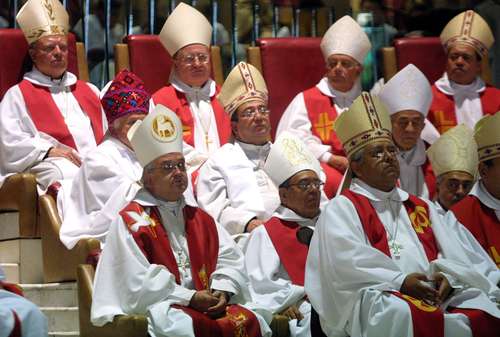
Obispos reunidos en la Basílica de Guadalupe en ocasión de la misa de apertura de una asamblea ordinaria de la Conferencia del Episcopado Mexicano; imagen de archivoFoto Yazmín Ortega Cortés

Carolina Gómez Mena

Periódico La Jornada
Domingo 15 de agosto de 2010, p. 29

Ante la situación de violencia que vive México, en la que cada vez hay “más asesinatos, ejecuciones realizadas por los narcotraficantes y crímenes atroces”, no cabe duda de que el mal está cundiendo, señaló Pedro Mendoza Pantoja, coordinador de exorcistas de la arquidiócesis de México, quien aseguró que todo esto es obra del diablo, aunque no en el campo de la posesión demoniaca, pero sí en el de la tentación.

En entrevista al comienzo del Congreso de Exorcistas y Auxiliares 2010 y del Curso Básico para Exorcistas, el cura señaló que cuando hay pérdida de valores, de sentimientos, de respeto al ser humano y de fe, y se cae en prácticas esotéricas y mágicas, se abren las puertas al diablo, el cual está ávido de meter su cola e influenciar a las personas.

No obstante, Mendoza Pantoja llamó a no endilgar todas las malas obras de los seres humanos, los pecados, a la acción directa del demonio, porque, dijo, finalmente es el hombre el que se deja engañar y cae, el que sucumbe a las tentaciones, por más que es libre de elegir.

El también sicólogo y médico naturista precisó que en un ambiente en el que prevalece el mal es necesario no sólo reavivar la fe en Cristo, sino asimismo contar con más sacerdotes que se dediquen al ministerio de la liberación, y en este sentido criticó que pese a las evidencias claras de que el mal existe haya jerarcas religiosos que pongan en duda su existencia.

“Si un obispo es incrédulo de la existencia del diablo no pondrá interés en este ministerio. Es importante que ellos se interesen, y ahora que daremos un curso que es único en su tipo –pues no ha habido uno así en el mundo–, es abierto a seminaristas, diáconos, laicos organizados, sacerdotes y feligreses, tienen la oportunidad de enviar a su gente”.

Precisó que no sólo en México existe poco interés por su especialidad y señaló que esto también radica en que hay desconocimiento de la tarea y en que ha permeado en el clero la corriente racionalista que niega la existencia del diablo.

Mendoza Pantoja llamó también a no dejarse tentar por ese ser maligno porque el diablo hace favores, pero después cobra impuestos, y caros, y subrayó que hay que estar atentos pues el demonio se aprovecha de muchas situaciones, por ejemplo de la desintegración familiar, del ansia de poder y de dinero, entre otras situaciones.

Asimismo indicó que la mayor parte de las veces lo que hay es sólo una influencia demoniaca, no una posesión; estas últimas son muy escasas.

Refirió que en los más de 10 años que lleva como exorcista cree no haber estado ante ninguna posesión real, sino sólo manifestaciones de problemas sicológicos o histerias. La literatura religiosa refiere que sólo una de cada 10 mil situaciones que se presentan como posesiones, realmente lo es.

Mendoza Pantoja insistió en la importancia de tener fe en Dios y a su juicio la principal tarea del exorcista no es tanto sacar al diablo, porque si metemos a Cristo, él es el que le da la patada y lo saca.

http://www.jornada.unam.mx/2010/08/15/index.php?section=sociedad&article=029n1soc

terça-feira, 10 de agosto de 2010

Brasil na disputa pela África

São Paulo, terça-feira, 10 de agosto de 2010


BB e Bradesco compram banco português na África

Instituições adquirem parte do BES, que atua em países como Líbia e Angola
Bradesco afirma que instituições brasileiras pretendem aplicar na África a sua experiência com bancarização

TONI SCIARRETTA
DE SÃO PAULO

O Banco do Brasil e o Bradesco decidiram fazer uma aliança para iniciar atividades na África, região considerada estratégica para a diplomacia brasileira. O objetivo, segundo o ministro Guido Mantega (Fazenda), é estreitar o relacionamento comercial e dar suporte aos negócios de empresas brasileiras na região.
Para chegar à África, os dois bancos optaram por comprar parte das operações do português BES (Banco Espírito Santo), antigo parceiro do Bradesco e que está presente em Angola, Moçambique, Cabo Verde, Líbia, Marrocos e Argélia. O BES tem 4,1% no Bradesco, que soma 6% do banco português.
Na África, os três bancos constituirão uma "holding" financeira, que controlará a rede de agências de varejo e o suporte ao comércio exterior e aos negócios de empresas brasileiras na região.
A "holding" atuará como plataforma para prospectar a compra de participações e fazer eventuais aquisições de bancos no continente. O desafio do grupo é entrar na África do Sul, um dos países de maior crescimento.
BANCARIZAÇÃO
Segundo o presidente do Bradesco, Luiz Carlos Trabuco Cappi, os bancos brasileiros pretendem aplicar sua experiência de bancarização no continente africano, onde os bancos locais só chegam a 15% da população.
"A África é a última fronteira de desenvolvimento do mundo. O continente está encontrando o seu caminho. Este salto é inevitável, é questão temporal."
O valor do negócio e a definição das participações de cada banco na nova empresa dependem de estudos de viabilidade técnica e jurídica. A expectativa é que o modelo saia entre 60 e 90 dias, segundo o diretor internacional do BB, Alan Toledo.
BANDEIRAS LOCAIS
O presidente do BES, Ricardo Salgado, afirmou que o banco português, que atua há quase cem anos na África, será majoritário. A proposta negociada é que os bancos trabalhem com parceiros locais e mantenham as operações com marcas dos bancos conhecidos dos africanos.
"Gostaria muito que não voltássemos ao espírito nacionalista da questão. Esse projeto, para ser vencedor, precisa utilizar a bandeira de cada país onde estiver instalado. Se pudermos ter parceiros locais, como temos em Moçambique e Angola, será magnífico", disse Salgado.
O BES abriu recentemente uma sede em Cabo Verde e tem cerca de 30 agências em Angola e outras 20 na Líbia. Em Moçambique, o BES fez uma parceria com o Moza Banco e, na Argélia, com o Banque Extérieure d'Algérie na área de leasing.
Planalto estimulou parceria entre BB e Bradesco na África, informa Kennedy Alencar
folha.com.br/me780356


http://www1.folha.uol.com.br/fsp/mercado/me1008201010.htm

sexta-feira, 6 de agosto de 2010

Que falta faz Leonel Brizola nos debates entre presidenciáveis!

Apesar das tentativas de Plínio de Arruda Sampaio, faltou hoje um Leonel Brizola no debate para quebrar os discursos arrumadinhos e especialmente quebrar as regras do debate. Esses debates engessados demais são muito chatos. Aparentemente ninguém ganhou o debate. Alguns comen tárisras dizem que o candidato Plínio de Arruda Sampaio ganhou, pode ser, ele foi divertido, criticou a todos igualmente, mostrou-se diferente. Por outro lado, não possui chances de vencer as eleições. A Marina foi chatinha como sempre, não entendo como ninguém da assessoria impõe a ela um treino de voz, em alguns momentos achei que ele mostrou mais desenvoltura do que a Dilma, mas faz um discurso certinho demais para quem é oposição e para quem, como o Plínio, deveria estar atirando para todo lado para viabilizar a candidatura. O Serra e Dilma foram normais. O Serra no final disse que a filha deve falou que ele não havia sorrido, isso não é problema, o problema é que nos closes não me parecia que ele estava sério, mas sim abatido, descaído, fraquejando. Em alguns momentos, apesar da imprensa ter dito que ele vestia um terno Ricardo almeida, o Serra tinha o porte do primo pobre. Mas obviamente mostrou mais desenvoltura do que a Dilma. A Dilma mostrou pouco desenvoltura, parecia tudo muito automático, se atrapalhou um pouco para falar. Mas apresentou autoridade e porte de presidente. Engraçado que se imaginava que seria mais difícil responder as críticas e perguntas do Plínio de Arruda Sampaio, porque poderia forçar um afastamento do discurso de esquerda. Mas nestas ela se saiu bem, me parece que ela mostrou mais dificuldade nas perguntas do Serra apesar delas terem sido básicas. Aparentemente pelo fato do confronto com o Serra ser mais essencial para o desenrolar das eleições ela ficou nervosa e não teve o mesmo desempenho do que no confronto contra o Plínio de Arruda Sampaio

quinta-feira, 5 de agosto de 2010

O ônibus gigante chinês!

Para diminuir trânsito, China terá ônibus gigante com espaço para movimentação de carros

Imagem: Divulgação
Imagem: Divulgação

A atual tecnologia de ponta existente na China permite que o país visualize soluções criativas para problemas das grandes cidades. Tendo em vista a diminuição do trânsito, a nova aposta é um ônibus gigante que permite a circulação de automóveis sob ele.

A ideia é que o veículo não ocupe o espaço das vias, permitindo maior circulação para carros e motos. A invenção visa também economizar despesas com a construção de metrôs e pontes.


http://www.advivo.com.br/blog/luisnassif/o-onibus-gigante-chines

domingo, 1 de agosto de 2010

LUIZ CARLOS BRESSER-PEREIRA Nacionalismo, liberalismo e capitalismo

São Paulo, domingo, 01 de agosto de 2010


LUIZ CARLOS BRESSER-PEREIRA
Nacionalismo, liberalismo e capitalismo

Quando Arábia Saudita e Egito se subordinam aos países ricos, é porque seu avanço econômico é lento

"THE ECONOMIST" (17 de julho) publicou editorial sobre o Egito e a Arábia Saudita (dois países ditatoriais aliados aos EUA no Oriente Médio) manifestando a esperança que se democratizem no futuro.
O surpreendente, entretanto, é que no mesmo número a revista faça resenha simpática de livro de Stephen Kinzer, ex-jornalista do "New York Times", que, depois de fazer a análise das revoluções nacionalistas e capitalistas em curso nesses países desde os anos 1920, defende a aliança dos Estados Unidos com a Turquia e o Irã.
Talvez essa atitude da grande revista liberal seja um sinal dos tempos. Reflita a desmoralização da ideologia "globalista" que caracterizou os 30 Anos Neoliberais do Capitalismo (1979-2008) -uma ideologia que condenava o nacionalismo dos países em desenvolvimento enquanto os países ricos praticavam sem hesitação seu próprio nacionalismo.
Historicamente, liberalismo e nacionalismo econômico sempre estiveram às turras, mas são ideologias complementares. Foi através do nacionalismo que os Estados-nação se formaram, e foi através desse processo que suas fronteiras foram ampliadas e que mercados internos amplos e seguros se constituíram viabilizando a industrialização.
Em outras palavras, foi através da combinação de nacionalismo e liberalismo que Estados-nação como a Grã-Bretanha, a França e os Estados Unidos realizaram suas revoluções capitalistas.
Só foi possível ao globalismo criticar o nacionalismo econômico (esquecendo quão diferente é do horrível nacionalismo étnico) porque o nacionalismo dos países ricos não estava ameaçado: ninguém nesses países duvida que o papel do seu governo é defender o trabalho, o conhecimento e o capital nacionais.
Sem dúvida, seria melhor um mundo sem nacionalismos, mas esse seria um mundo encantado. Na realidade, a sociedade mundial está hoje organizada em famílias, organizações e Estados-nação.
Espera-se que cada indivíduo, primeiro, se solidarize com sua família, com as organizações das quais participa, e com seu país, para, depois, buscar interesses comuns e defender a cooperação entre todos. O globalismo ensina (e as elites dependentes acreditam) que os países ricos estão prontos a cooperar; não percebem que o que realmente os move são seus interesses nacionais.
Quando países como a Arábia Saudita e o Egito se tornam subordinados aos países ricos, isso significa que suas elites estão alienadas, que seu desenvolvimento econômico é lento, que a corrupção é elevada, e que a desigualdade econômica só aumenta.
Quando países como o Irã usam da religião para fortalecer seu nacionalismo, estão adotando uma velha prática para alcançar coesão nacional e completar sua revolução capitalista -uma condição essencial para que transitem para democracias consolidadas.
Enquanto os países ricos não compreenderem que esse nacionalismo religioso não é contra eles, enquanto seus porta-vozes continuarem a criticar o governo autoritário do Irã, enquanto apoiam ditaduras que não oferecem nenhuma perspectiva a seu povo, como a Arábia Saudita e o Egito, eles estarão trocando interesses de curto prazo de algumas de suas empresas pelo seu próprio interesse nacional.

http://www1.folha.uol.com.br/fsp/mundo/ft0108201010.htm

Por prestígio, Brasil ajuda países pobres

São Paulo, domingo, 01 de agosto de 2010


Por prestígio, Brasil ajuda países pobres

Governo brasileiro dissemina doações, ações sociais e transferências para nº cada vez mais amplo de parceiros
Objetivo desse "soft power" é conquistar simpatias, influência política e votos em órgãos internacionais

Pedro Sá da Bandeira - 16.out.2008/Efe

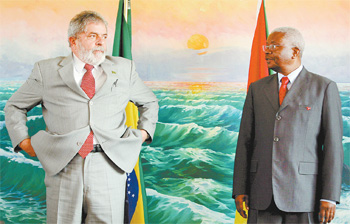
Lula ao lado do presidente de Moçambique, Armando Guebuza, em Maputo; país é um dos recipientes da ajuda brasileira
ELIANE CANTANHÊDE
COLUNISTA DA FOLHA
JOHANNA NUBLAT
DA SUCURSAL DE BRASÍLIA

Enquanto os Estados Unidos aumentam em mais US$ 59 bilhões o orçamento para as guerras no Iraque e no Afeganistão, o Brasil investe no chamado "soft power", disseminando doações, ações sociais, treinamento de pessoal e transferência de tecnologia para um número cada vez maior de países pobres, ou nem tanto, da América Latina, África e Ásia.
O objetivo é conquistar simpatias que convertam em influência política e votos, não apenas para obter a sonhada vaga no Conselho Permanente de Segurança das Nações Unidas, mas também para vencer disputas em organismos e instituições internacionais.
O Brasil anda mesmo precisando de votos, depois das derrotas para a OMC (Organização Mundial do Comércio), para o BID (Banco Interamericano de Desenvolvimento) e para a Unesco (o órgão da ONU para educação). A última foi na eleição do diretor-executivo do Escritório da ONU para o Combate ao Crime e Drogas.
O "soft power" está acelerado. Na sexta-feira passada, enquanto o presidente Luiz Inácio Lula da Silva estava no Paraguai, visitando linhas de transmissão de energia que o Brasil financia no país, o Itamaraty divulgava em Brasília a liberação de US$ 500 mil para refugiados colombianos no Equador.
O maior alvo do "soft power" é o Haiti, o país mais pobre das Américas e que acaba de sofrer um terremoto devastador.
O Brasil detém o comando militar das tropas de paz da ONU no país, o governo destinou US$ 15 milhões logo após a tragédia, e Lula enviou proposta ao Congresso para um adicional de R$ 375 milhões.
Além disso, o Brasil atua na reativação da produção agrícola no país, fez contribuição voluntária de US$ 130 mil via Programa Mundial de Alimentos, enviou mais US$ 50 mil para a embaixada em Porto Príncipe distribuir água e comida e doou US$ 55 milhões para o Fundo de Reconstrução do Haiti.
Há duas coordenações desse "saco de bondades", ambas do Itamaraty. Uma é a ABC (Agência Brasileira de Cooperação), e a outra, a CGFome (Coordenação Geral de Ações Internacionais de Combate à Fome).
O orçamento da ABC foi de R$ 18,7 milhões em 2006 para R$ 52,6 milhões neste ano, enquanto a equipe pulou de 90 para 160 funcionários de 2009 para 2010. São 56 países assistidos, e o valor é considerado pequeno. Se computasse a hora técnica (remuneração dos profissionais) seria cinco vezes maior, estima o diretor da agência, ministro Marco Farani.
A fila dos que recebem ajuda é encabeçada por Moçambique,Timor Leste, Guiné Bissau, Cabo Verde, Paraguai, Guatemala, São Tomé e Príncipe, Angola, Uruguai e Cuba. E inclui Autoridade Nacional Palestina, Níger, Burundi, Uganda, Serra Leoa e Nigéria, entre outros.
FILOSOFIA DA AJUDA
A filosofia da ajuda, como diz, é fazer doações só em casos de emergência, privilegiando "sustentabilidade". Exemplo: o projeto "Cotton 4", de US$ 4 milhões, para desenvolver a indústria de algodão em Mali, Chade, Benin e Burkina Fasso.
Já o CGFome tenta exportar experiências brasileiras (como destinar alimentos da agricultura familiar para escolas) inclusive para o Chile, que não é pobre.
Mas são finalidades variadas e, só em junho deste ano, foram R$ 6 milhões para ajuda, entre outras, às vítimas dos episódios recentes de violência no Quirguistão, a reassentamentos no Sri Lanka e à recuperação do inverno rigoroso na Mongólia.
O coordenador do grupo, ministro Milton Rondó Filho, disse que o orçamento passou de R$ 2,4 milhões em 2007 para cerca de R$ 50 milhões neste ano, segundo ele, para "reforçar a solidariedade e os gestos políticos brasileiros no mundo".
Segundo o embaixador Piragibe Tarragô, subsecretário do Itamaraty para África, respalda a política Sul-Sul, de aproximação com países pobres e emergentes. "O Brasil quer ser reconhecido e ter influência."
A investida já foi tema de reportagem da revista britânica "The Economist", mas com um alerta: "O país ainda tem grandes bolsões de pobreza, e o envio de dinheiro para o estrangeiro pode ser controverso".
O presidente da Comissão de Relações Exteriores do Senado, Eduardo Azeredo (PSDB-MG), concorda: "É uma ação tortuosa. Se você fala em Haiti e países muito pobres, é correto. Mas a busca pelo protagonismo fez com que o Brasil exagerasse nas suas relações e na sua bondade", disse.
A oposição tenta impedir a revisão do Tratado de Itaipu, alegando que o aumento do preço da energia excedente que o Paraguai vende ao Brasil pode custar R$ 5,5 bilhões. "Vamos resistir", diz.

Vulnerabilidade da economia global

World economy: Vulnerable to vertigo

By Chris Giles

Published: July 27 2010 23:00 | Last updated: July 27 2010 23:00

rollercoaster

Double dip. It is the phrase on everyone’s lips – and it makes many of those lips tremble. With the shock of 2008 fading into memory, the moment of reckoning for the global economy has arrived. Will the bounce back from the nadir become established as a return to sustainable expansion – or will initial relief mutate into the despair of a renewed slowdown?

There is no doubt that the mood has soured since spring as Europe’s authorities flapped in the face of a sovereign debt crisis, thus intensifying its effects. Just take a – however unscientific – survey of English-language media over the past six months: while mentions of a V-shaped recovery have remained constant, references to a double dip have soared. They were almost four times as high in July as in May.

Such talk is fuelling the doom-mongers. Chief among them, Nouriel Roubini, chairman of Roubini Global Economics, argued last week that a downturn in the global economy “will accelerate in the second half of the year”. For Europe and Japan, “avoiding double-dip recession will be difficult”, he said. Indeed, right on cue, manufacturing activity indicators weakened in June for China, South Korea, Taiwan, India and Australia.

Gloom has spread to policymakers in the world’s largest economy. Revising forecasts down for the first time since 2009, Ben Bernanke, Federal Reserve chairman, told Congress last week that the US outlook was “unusually uncertain”. America’s central bank chief added: “We are ready and we will act if the economy does not continue to improve, if we do not see the kind of improvements in the labour market that we are hoping for and expecting.”

Lawrence Summers, chief economic adviser to President Barack Obama, described the world’s leading economies as “in or near liquidity trap conditions”, which translates as implying that they are so weak that lower interest rates and other monetary policy tools are ineffective stimulants. No matter how much money is thrown into the system, people are so nervous that they just hoard it.

Double dip recession?

But dwelling on the negative does not tell the whole story. Although fears have grown, the data do not point ominously downward. Instead, led by a remarkable expansion in emerging economies, the world economy has surprised almost everyone by growing as fast in 2010 as it was before the financial crisis.

While the International Monetary Fund’s forecast for this year languished at 1.9 per cent in April 2009, it has subsequently been revised five times, every time higher, so it now stands at 4.6 per cent. World trade is rising at double-digit rates and, even in the advanced world, upgrades in growth forecasts have outweighed downgrades. Germany’s economy is now expected to have grown by more than 1 per cent in the second quarter; Britain’s statistical office recorded growth of 1.1 per cent for the same period, the fastest rate for four years.

These positive straws in the wind have led some European policymakers to make more strident calls for fiscal tightening than they would have dared to a year ago. Jean-Claude Trichet, European Central Bank president, last week called for tightening everywhere. “With hindsight, we see how unfortunate was the oversimplified message of fiscal stimulus given to all industrial economies under the motto: ‘stimulate’, ‘activate’, ‘spend’!” he wrote in the Financial Times.

In spite of concerns about a double dip, the vast majority of economists still predict continued recovery, even if they reckon the global economy will slow in the second half of 2010. Willem Buiter, chief economist at Citigroup, expects no huge shock from Europe. “It’s a pathetic recovery, but no more pathetic than expected before the sovereign debt crisis.”

Of course, Mr Trichet knows the future no better than Mr Bernanke, Mr Roubini or Mr Buiter. And apart from in the very short term, economic forecasts impart little valuable information. Using past forecast errors as a guide, the new UK Office for Budget Responsibility sees an 80 per cent chance that the British economy will grow between a negative 0.4 per cent and a positive 4.7 per cent in 2011, a range so wide it encompasses both boom and bust. Not much more helpful in divining the future is its calculation that there is a 50:50 chance that 2011 growth will either be below 1.2 per cent or above 3.9 per cent.

What is true for the UK also applies to the global economy, according to Michael Dicks of Barclays Wealth. Uncertainties over the US consumer, European monetary union survival and Asian inflation mean “macroeconomic forecast needs to be scenario-based currently, rather than the more usual ‘best-guess’ variety”.

So what could cause a global double dip? There are four big risks: a general slide in confidence, the unwinding of temporary boosts to growth, a sudden financial implosion, and a bad reaction to fiscal austerity.

Confidence wanes

First among the causes for concern is the effect of falling business and household confidence, the glue holding the global recovery together. The initial sign came in May when the global purchasing managers’ index for both manufacturing and services fell from the April peak as activity and new orders dropped.

The declines continued in June, fuelling fears that the rapid phase of the recovery could be short-lived. But July’s results for Europe – the main cause for concern in the spring – were much more encouraging. “This suggests that hardly any of the strong growth momentum of the second quarter of 2010 has been lost so far,” says Greg Fuzesi of JPMorgan, with gross domestic product “still appearing to be growing comfortably above a 2.5 per cent annualised pace at the start of the third quarter”.

Households have also shown few signs of a slide back into a fear of spending. Though in most recession-hit countries they have been saving much more than before the crisis, savings rates have stopped rising. At current rates, households will be able to reduce debt without detracting further from economic growth.

Temporary boosts end

A second concern is that the recovery has been driven far too much by temporary features of post-recession economies – such as companies rebuilding stock levels. Given the US reliance on changes in inventories for the majority of its growth in the past two quarters, Mr Bernanke for one is worried. In his semi-annual report he told Congress this month that “fiscal policy and inventory restocking will likely be providing less impetus to the recovery than they have in recent quarters”.

But even many traditionally gloomy forecasters agree there is still sufficient momentum in these economies to prevent a double dip resulting from an end to the inventory cycle alone.

Julian Jessop of Capital Economics says the “recoveries in the US and China appear to be slowing to a more sustainable pace rather than coming to a complete halt”. Incoming data on investment and consumer spending have been quite good, he says. “Growth was always likely to slow once these boosts began to fade. However, this slowdown need not develop into a double dip.” In China, where annual growth slowed to 10.3 per cent in the second quarter from 11.9 per cent in the first, the slowing helps “avoid overheating and assist in the transformation of our economic model”, reckons Sheng Laiyun of the National Bureau of Statistics.

A crisis returns

The third fear is that it is just a matter of time until another crisis strikes, in Europe’s sovereign debt market. As with the collapse of Lehman Brothers in 2008, a sudden fissure would wreck all analysis based on recent trends.

Recognising this risk, the IMF says recent market turbulence “has cast a cloud over the outlook” and if confidence and growth did implode in Europe, “the negative growth spill-overs to other countries and regions could be substantial because of financial and trade linkages”. In a test model of a similar disaster in Europe to the end of 2008, world growth would fall by 1.5 points in 2011, the IMF estimated, and the eurozone would suffer a serious double dip.

Luckily for the world, the signs this spring that implosion was imminent, and the faltering response of European governments in putting bail-out plans in place, never quite became a wider crisis. As Holger Schmieding at Bank of America Merrill Lynch says: “Greece is staging an impressive fiscal turnround; Spain has come through its July peak funding season with flying colours. The risk that Spain may fall noisily into the safety net soon has receded.”

The longer Europe muddles along without a new crisis, the more remote the risk of a sudden implosion becomes. According to Mr Buiter, “the disaster scenario of sovereign defaults is no longer on the table except as a tail risk”. Last week’s European bank stress tests might represent another small step away from the brink.

Austerity bites

Fourth, if the financial crisis risk is very real, but diminishing, the risks to the global economy from fiscal austerity have without doubt risen. Government budgets have been tightened around the world since Europe’s crisis in May, providing an additional headwind at a time when there is a natural tendency for economies to slow.

Economists agree fiscal policy needs to tighten but disagree over the timing of tax increases and spending cuts and the speed of deficit reduction. Even the IMF is nervous. “Most advanced economies do not need to tighten before 2011 because tightening sooner could undermine the fledgling recovery, but they should not add further stimulus,” it says.

But the heat generated by the theoretical economic debate on fiscal austerity can exaggerate the economic significance of the budgetary policies actually planned. Neither extreme tightening nor extreme stimulus are on the table in any significantly sized advanced or emerging economy. On average, to cut deficits the advanced members of the Group of 20 leading economies plan spending and tax measures worth 1.25 per cent of national income in 2011, up from 1.1 per cent before Europe’s debt crisis. Emerging markets are tightening budgets by 0.85 per cent of national income, up from 0.65 per cent in April.

The extra tightening is not big enough to push the world back into recession if the IMF’s baseline forecasts of an expansion of 4.3 per cent globally and 2.4 per cent in advanced economies are reasonable.

. . .

So with each of the four big risks becoming less dangerous – or unlikely on its own to push things back over the edge – and with confidence holding up, the vast majority of economists simply expect something of a grind in the years ahead. The picture is one of slow underlying growth coupled with austerity in the public sector in advanced economies and much faster growth in the emerging world.

We can expect “an extended period of relatively sluggish industrial country growth over the next few years, capped by poor credit availability, fiscal consolidation and high private debts”, says Michael Saunders of Citi.

But equally, no one can be sure that the current, just about benign, trends will last and it is safe to sound the all clear. Lord Stern, former chief economist of the World Bank and academic at the London School of Economics, says the uncertainties spoken about by Mr Bernanke are all too real. “We do not know what may happen to consumer and investor confidence; it is absurd to pretend otherwise.”

THE AMERICAN EXPERIENCE

Even the toughest stress tests cannot ensure a revival of bank lending

Hopes were initially high that last Friday’s stress tests of 91 European banks would improve the resilience of the financial system and its ability to support the recovery. Earlier this month, Jean-Claude Trichet, European Central Bank president, spoke about the process “laying the foundations for sustainable growth, job creation and financial stability”. The authorities expect the results of the tests – failed by only seven institutions – to remove one reason at least to doubt the sustainability of the recovery.

Publication of the results was intended to alleviate the problem of “incomplete information”. Because providers of funds to banks cannot be certain of the quality of the assets on their balance sheets, they require a premium to lend. At times of financial turmoil, as in the 2008 credit crunch, the premium grows so large that the bank funding market dries up, inhibiting lending and slowing the economy.

To stop such a vicious circle taking hold, says Peter Westaway of Japanese investment bank Nomura, tests should be designed to “free up the information logjam”. He says: “A successful set of bank stress tests can set in train the virtuous circle whereby the banking system again facilitates the conditions for economic recovery in Europe.” With most analysts dismissing last week’s tests as too easy, that looks unlikely.

A deeper problem, however, is that an increase in the quantity and quality of information cannot guarantee looser credit conditions and faster growth. The more stringent US stress tests of spring 2009 – failed by 10 out of 19 banks and generally held to be successful – set a worrying precedent.

Ben Bernanke, Federal Reserve chairman, said in May that, “by setting reasonably ambitious capital targets, we hoped also to hasten the return to a better lending environment. Clearly that objective has not yet been realised, as bank lending continues to contract and terms and conditions remain tight.”

This suggests the European version is unlikely to be the catalyst to a faster recovery on the continent. “The stress tests alone will not encourage lending,” says Michael Hanson of Bank of America Merrill Lynch. “They will not jump-start the economy and they will not resolve fiscal crises.”

http://www.ft.com/cms/s/0/fb12dc06-99ad-11df-a852-00144feab49a.html

Debates sobre Touradas na Espanha

image


http://www.elpais.com/vineta/?d_date=20100801&autor=Ram%F3n&anchor=elpporopivin&xref=20100801elpepuvin_1&type=Tes&k=Ramon

O Exército Chinês

Cavalry trained in N China to greet 83rd anniversary of PLA founding

2010-08-01 06:43:21 GMT2010-08-01 14:43:21 (Beijing Time) Xinhua English

Cavalry men have a military training on Xilingol grassland, north China's Inner Mongolia Autonomous Region, July 31, 2010, to greet the upcoming 83rd anniversary of the founding of the People's Liberation Army (PLA) that falls on August 1. (Xinhua/Zhu Yuanli)

Cavalry men have a military training on Xilingol grassland, north China's Inner Mongolia Autonomous Region, July 31, 2010, to greet the upcoming 83rd anniversary of the founding of the People's Liberation Army (PLA) that falls on August 1. (Xinhua/Ding Xiaochun)

Cavalry men have a military training on Xilingol grassland, north China's Inner Mongolia Autonomous Region, July 31, 2010, to greet the upcoming 83rd anniversary of the founding of the People's Liberation Army (PLA) that falls on August 1. (Xinhua/Zhu Yuanli)

Cavalry men have a military training on Xilingol grassland, north China's Inner Mongolia Autonomous Region, July 31, 2010, to greet the upcoming 83rd anniversary of the founding of the People's Liberation Army (PLA) that falls on August 1. (Xinhua/Zhu Yuanli)

Cavalry men have a military training on Xilingol grassland, north China's Inner Mongolia Autonomous Region, July 31, 2010, to greet the upcoming 83rd anniversary of the founding of the People's Liberation Army (PLA) that falls on August 1. (Xinhua/Ding Xiaochun)

Cavalry men have a military training on Xilingol grassland, north China's Inner Mongolia Autonomous Region, July 31, 2010, to greet the upcoming 83rd anniversary of the founding of the People's Liberation Army (PLA) that falls on August 1.

EMAIL | PRINT | RSS

Source:http://english.sina.com/china/p/2010/0731/331704.html

Hegemonía de Brasil y Argentina sobre Paraguay

CONFERENCIA DEL PROFESOR FERNANDO HENRIQUE CARDOSO

Hegemonía de Brasil y Argentina sobre Paraguay

por

Gustavo de Gásperi (*)

Gracias a la gentileza del Banco Itaú tuve la oportunidad de asistir a la conferencia del profesor Fernando Cardoso en la que abordó el tema vinculado a la ubicación del Brasil en el contexto regional.   
El privilegio de escuchar a un maestro en el pensamiento económico, social y político, reconocido y admirado en su país y en el mundo por su orientación, que enfatiza el desarrollo social sobre las reglas de la economía clásica, fue para mí muy breve, por lo que no me resulta fácil reproducirlas en mi mente, pese al deseo insatisfecho de profundizar sus ideas, expresadas con la sencillez que supone el dominio de los temas y la notoria experiencia del conferencista para exponerlas.   
No obstante, mi atención se detuvo cuando hábilmente descartó la posibilidad de que la política del Brasil sea vista como hegemónica en la región. Repitió el profesor Cardoso dos o tres veces la palabra hegemonía, como si  no fuera posible imaginar tal intención, o como si no debiera verse la voluntad dominante del Brasil, sin perjuicio de la gravitación natural de los recursos que posee, adquiridos en gran parte merced al desarrollo de su población, el esfuerzo de las universidades, la apertura democrática de la vida del Brasil y la orientación social favorable a la adquisición de los valores, que son la lógica consecuencia del esfuerzo como nación.
Puede ser que mis palabras no traduzcan con exactitud el pensamiento del expositor, pero sí expresan lo que mi mente entendió del veloz lenguaje empleado, admirable por el dominio de los temas.   
No obstante, quiero insinuar mi discrepancia, por supuesto dentro del máximo respeto al ilustre conferencista, en cuanto a que, en relación al Paraguay, no ejerza el Brasil una voluntad hegemónica.
Creo que el Brasil y la Argentina utilizan los Tratados de Itaipú y Yacyretá como una forma de supremacía de ambos Estados sobre el Paraguay, con grave detrimento para su economía, su desarrollo social y su acceso a los niveles de participación en los mercados globales, tan necesarios hoy para el crecimiento interno de las naciones.   
La estructura jurídica de ambos Tratados, que son idénticos, con algunas salvedades, configura un fraude a su propia finalidad, a su objeto, que es la generación de energía hidroeléctrica sobre la base de su división en partes iguales. El fraude en perjuicio del fin de los Tratados desvía la intención expresada en los mismos, y la desviación se materializa en la más inicua reducción de los derechos del Paraguay, y de su dignidad, a una mínima expresión.   
Los flujos de caja son administrados y retenidos por ambas naciones contratantes, Brasil y Argentina, que retienen los fondos a su antojo, bajo la apariencia de respeto a las convenciones bilaterales, deformadas en anexos que conducen a la conversión de la mitad que corresponde al Paraguay en un ridículo porcentaje al cual accede mediante la mendicidad a que son sometidos los sucesivos gobiernos.   
Hemos llegado a un punto en que el Paraguay necesita recibir ese mínimo, a pesar de la miseria de su importancia, como un cuerpo humano asfíctico necesita del oxígeno que le rodea. Da pena ver a la propia patria en tal circunstancia, empobrecida, incapaz de reaccionar, frágil en la capacidad de sus dirigentes políticos y amenazada por un futuro que no permite imaginar una liberación de la hegemonía de los vecinos, iniciada en tiempos de la autocracia detestable.   
Quiera el profesor Cardoso comprender que su figura ejemplar trasciende la miseria explicada en mis expresiones que anteceden, pero mi condición de ciudadano de esta hermosa nación que es el Paraguay, me obliga a soñar con su participación en el contexto regional.   
(*) Abogado. Columnista invitado

24 de Julio de 2010 22:23

http://www.abc.com.py/abc/nota/157323-Hegemonia-de-Brasil-y-Argentina-sobre-Paraguay/

Lugo: ¿fraternidad mendicante o interés nacional?

Lugo: ¿fraternidad mendicante o interés nacional?

por

Ing. Nelson Cristaldo (*)

Resulta cómico observar cómo el presidente Lugo y sus asesores se agitan ante la incertidumbre de la venida del presidente Lula para “la palada inicial” de la subestación de Villa Hayes. Sera aún más fascinante ver el montaje y el espectáculo preparado para exaltar “la fraternidad” y la “buena voluntad” de los mandatarios. Por supuesto, debemos esperar las importantes declaraciones, que seguramente seguirán las mismas líneas que se han repetido una y otra vez:   
- El Brasil, “como pueblo hermano”, rechaza la idea de ver a su vecino hundido en la pobreza. El Brasil, “futura potencia mundial”, toma la responsabilidad social de ayudar al Paraguay con el regalo de 400 millones de dólares para la construcción de la línea de 500 kV (!).   
- El Paraguay, mediante “los avances diplomáticos”. Se da inicio a la construcción de la línea de 500 kV, la cual será una pieza clave para afianzar la soberanía hidroeléctrica (Artículo “Línea de 500 kV afianza la soberanía hidroeléctrica”, Ing. Ricardo Canese, Gran teórico de las reivindicaciones paraguayas).   
Este lindo escenario es perfecto para ambos mandatarios: Por un lado el presidente Lula que intenta laurearse con el Nobel de la Paz; trabajando a favor de  la fraternidad entre naciones (Paraguay-Brasil, Cuba-Brasil, Fortaleciendo el Mercosur, etc.) y actuando de intermediario y resolviendo conflictos internacionales (Irán-EEUU, Colombia-Venezuela, etc.). También para el presidente Lugo este es el escenario perfecto porque puede utilizar sus únicas herramientas conocidas: pedir limosna apelando a la fraternidad.   
Este gran montaje pretende convencer al pueblo paraguayo del gran logro en la recuperación de la soberanía mediante el regalo de la línea de 500 kV y de la buena voluntad del Gobierno brasileño para resolver la pobreza paraguaya. Sin embargo, la realidad es muy distinta. El Gobierno brasilero no busca resolver los problemas del Paraguay, y no debería de hacerlo. De hecho, sería una gran irresponsabilidad del gobierno de Lula buscar la fraternidad y la solidaridad con el Paraguay por encima de los intereses nacionales del Brasil.   
La línea de 500 kV nunca formó parte de los reclamos paraguayos y nunca debió formar parte de los puntos negociados con el Brasil. Entonces, ¿el regalo de la línea de 500 kV es un logro para el Paraguay? La respuesta es un rotundo “NO”. Muy por el contrario, es el sometimiento del pueblo paraguayo a la voluntad de los políticos del Brasil por los próximos tres años. Tiempo que durará el desembolso financiero del Brasil para la construcción de la línea. Este es sin duda un precio muy alto que pagará el Paraguay. ¡La línea de 500 kV es un logro del Brasil, felicidades Lula!, ¡Más sometimiento para el Paraguay, grande Lugo!   
De la misma forma, la mejora de los valores de compensación por energía cedida al Brasil que será ajustado por el factor multiplicador de 15.3 es también un resultado mendicante. ¿Cómo determinaron el factor de 15.3? No hay respuestas, este valor fue determinado de forma completamente arbitraria y no representa el valor de mercado de la energía cedida. La mejora de las compensaciones tampoco representa un logro para el Paraguay. ¿Qué hará el gobierno de Lugo con 200 millones de dólares más? Para que los lectores tengan una idea, este monto alcanza justo lo que la ANDE debería invertir anualmente para mantener el sistema eléctrico operando en condiciones satisfactorias bajo los criterios de seguridad y confiabilidad. Esta suma no resuelve el problema de la pobreza paraguaya.   
El presidente Lugo debe asumir su rol de administrador de un país y buscar el interés nacional como punto eje de su administración, dejando de lado el esquema mendicante que ha empleado hasta ahora. Para lograr el despegue de la economía paraguaya y quitar de la pobreza a este pueblo sufrido, el presidente Lugo debe  crear las condiciones necesarias para la industrialización del país. Esto se logra generando las oportunidades de negocios, abriendo el sector eléctrico a la participación privada, atrayendo los grandes capitales extranjeros al sector industrial y eléctrico. La administración del presidente Lugo debe promover la integración energética regional con los países vecinos, no exhortando a la fraternidad ni suplicando la solidaridad, sino promoviendo las oportunidades de negocios e intercambio entre naciones, única herramienta que se ajusta al interés nacional de las mismas.   
El Paraguay es un país rico en recursos naturales para generación de energía limpia y barata. Nuestro desarrollo económico, nuestra seguridad energética y nacional no pueden depender de la voluntad de políticos y burócratas de países vecinos. El Paraguay es un pueblo digno que debe  tomar el control de su destino y proyectarse al mundo como un país libre de conflictos internacionales, seguro para las inversiones extranjeras y con un predecible sistema financiero y económico.   
Ni el Brasil con Itaipú ni Argentina con Yacyretá son los culpables de nuestra pobreza. Somos nosotros y nuestros administradores los únicos culpables de no atender el Interés Nacional. Y, así mismo, somos nosotros los únicos responsables de salir adelante como país. Presidente Lugo, no nos haga perder otros 5 años y aproveche el tiempo que le queda para no entregar un Paraguay a oscuras.   
(*) Ing. Nelson Cristaldo: Recibió el título de ingeniero eléctrico en Temple University, USA y el título de máster en ingeniería en sistemas de potencia en Florida International University, USA. Actualmente se encuentra trabajando como consultor del área de Planificación Energética.

27 de Julio de 2010 22:52

http://www.abc.com.py/abc/nota/158969-Lugo-fraternidad-mendicante-o-interes-nacional/

El “hijo de puta” en Argentina, tem até um dia de celebração

El insulto devaluado

TEXTO JOSÉ VALES • CORRESPONSAL
El Universal
Domingo 01 de agosto de 2010

Expresiones que en muchos países resultarían ofensivas, en Argentina bien pueden usarse como elogios

BUENOS AIRES.— Todavía no se lo ha declarado festivo, pero por algo se empieza. Mañana, 2 de agosto, los argentinos celebrarán por primera vez “el día del hijo de puta”, a instancias del piquetero oficialista y ex funcionario de gobierno Luis D’Elia, quien propuso, para tan peculiar evento, utilizar la fecha del cumpleaños del ex dictador Jorge Rafael Videla.

Pero en Argentina, la expresión “hijo de puta” es tan común como lo es en México el “güey”, al punto que hay quienes hablan de la “devaluación del insulto”.

La propuesta de D’Elia encontró eco de inmediato. Más de 46 mil usuarios en la cuenta de Facebook, y Barcelona, una revista de humor que parodia al matutino Clarín, apoyaron la moción. Barcelona incluso presenta, en su más reciente edición, una galería de fotos con “hijos de puta” famosos, donde aparecen varios represores, así como los ex ministros de Economía José Alfredo Martínez de Hoz y Domingo Cavallo y hasta el ex presidente Carlos Menem. Pero el cumpleaños 85 de Videla, la cara visible de la dictadura (1976-1983), ha sido la fecha escogida por haber sido él el primero de los presidentes de facto y porque aún se siguen acumulando procesos y condenas en su contra por violaciones a los derechos humanos.

Apenas el 7 de julio fue condenado a cadena perpetua por el asesinato de 31 presos políticos.

Pero la hijoputez nacional no se termina en Videla, según lo aclaró en su momento D’Elia.

“Acá ha habido un montón de hijos de puta: Menem, (Eduardo) Duhalde y (Fernando) de la Rúa, el ex ministro Domingo Cavallo... Podría nombrar tranquilamente 150 ó 200 hijos de puta”, dijo. Cuando le preguntaron si el ex presidente Kirchner se engloba también en esa categoría, D’Elia no dudó en responder que “es también un hijo de puta… aunque en el buen sentido”.

Y es que, en Argentina, el más grande de los insultos del castellano puede ser también el mayor de los elogios.

“¡Qué hijo de puta!” suele decirse cuando alguien se destaca en una jugada en el futbol. También puede ser un florido piropo. ¡Qué hija de puta, qué joven que te ves!”. La expresión es tan común como otras que suelen utilizar desde adolescentes argentinos de 16 años hasta adultos de 40 ante cualquier pregunta: “Nada. Estaba trabajando, pero nada. Tenía ganas de tomar un café, nada… pasar el rato.”

“Nada”, como carencia de ideas, que bien puede significar que “no pasa nada” o que estamos en eso, “en la nada”.

Otra perlita: el “no” antepuesto a cualquier respuesta o el “Digamos”, decorando hasta la más nimia explicación. “No, pero bien….”, “digamos que estamos en un modelo de acumulación… Digamos que eso representa al país…. Digamos, digamos…” metido dos, tres, cuatro veces en cualquier enunciado que, al final, no dice nada.

De esta suerte, la “hijoputez”, como recurso lingüístico se usa tanto para referenciar al generoso y al estafador, o al “Señor o al ladrón”, en honor a esa Biblia argentina que es el tango “Cambalache”. “Todos somos un poco hijos de puta, si querés. Siempre en nuestros términos: los Videla y los Messi, por su genialidad con la pelota; por haber cometido algún acto indebido, alguna cagada o por haber hecho algo muy bueno”, explica Pablo Marchetti, director de Barcelona y líder de la banda de rock Falopa.

Mañana será, pues, “el día del hijo de puta”, un día para recordar la etapa más siniestra y despreciable de la historia reciente del país. Y, en medio de tantos significados que “hijo de puta” pueda tener, éste no deja de ser un aliciente, porque significa comenzar a llamar las cosas por su nombre y reconocer a cada quien con su calificativo apropiado.

http://www.eluniversal.com.mx/internacional/vi_69056.html

El Migrante

image

http://www.eluniversal.com.mx/wcarton10364.html

México retoma relações com Honduras

Otro error de la actual política exterior mexicana, opina académico

Emir Olivares Alonso

Periódico La Jornada
Domingo 1º de agosto de 2010, p. 5

La decisión del gobierno de México para normalizar sus relaciones con Honduras representa un aval a un régimen surgido de un proceso irregular que a su vez se derivó del golpe de Estado que derrocó al presidente Manuel Zelaya, consideró Edmundo Hernández-Vela, profesor emérito de la Facultad de Ciencias Políticas y Sociales de la Universidad Nacional Autónoma de México.

Especialista en política exterior, el doctor Hernández-Vela dijo que la decisión de la cancillería es sólo una ocurrencia personal que no sorprende, pues desde hace años la política exterior del país es inadecuada.

Supongo que sólo es una inercia por mantener buenas relaciones con otros países, independientemente del régimen. Pero se trata de un precedente nada favorable que representa una especie de aval a lo sucedido [el golpe de Estado de junio de 2009] y un premio para el nuevo régimen [de Porfirio Lobo] que surgió de forma irregular tras el golpe. Esto no habla muy bien de una política firme y de apoyo a la no injerencia y a la no influencia en asuntos internos y la toma de decisiones de otras naciones.

Entrevistado luego del anuncio de la cancillería sobre la normalización de relaciones, el académico sostuvo que el problema de la decisión no tiene que ver con el tipo de gobierno que pueda representar Lobo, sino con la manera irregular en la que surgió su administración.

Es obvio que el régimen surgió del propio golpe de Estado, no de un proceso limpio. Incluso, sin juzgar si Zelaya lo había hecho bien o mal, correspondía a los propios hondureños pronunciarse y no desde afuera. Pero México, como muchos otros países, entendieron que Estados Unidos vio con mucha simpatía lo que sucedió en Honduras.

El internacionalista consideró que el gobierno de Felipe Calderón pudo prorrogar la determinación de normalizar relaciones con el país centroamericano. Pudimos haber esperado hasta que los hondureños decidieran, en nuevas elecciones, qué tipo de gobierno quieren. Y no en este proceso que se deriva de los propios golpistas y de quienes los apoyaron, pues incluso la Corte hondureña avaló algo impropio [al señalar que el golpe de Estado no era ilegal].

Agregó que el apoyo de la administración mexicana al régimen de Lobo representa un error, porque el gobierno del hondureño no fue producto de la manifestación libre de los habitantes de ese país. Éste es uno más de los errores de la actual política exterior mexicana, que es un tanto acomodaticia.

Ejemplificó con el propio caso mexicano los perjuicios de un proceso electoral irregular: En México, por más que se haya tratado de encubrir, las últimas elecciones presidenciales se deben calificar, al menos, de irregulares. Esto no favorece nunca los intereses de la nación, sino los de políticos vinculados con capital extranjero y los de grupos hegemónicos, que son los que hacen que ahora nuestra política exterior esté paralizada.

http://www.jornada.unam.mx/2010/08/01/index.php?section=politica&article=005n2pol